- +91 9274867875
- balajihorizoneyehospital@gmail.com
- Science City
- Naranpura

Keratoconus is a progressive condition in which the normally round cornea (the clear front window of the eye) gradually thins and bulges into an irregular cone shape. This distorts vision and, if it progresses, can significantly affect sight. The encouraging news is that with early diagnosis, progression can usually be halted — and most people keep good, functional vision.
The cornea focuses light onto the retina. In keratoconus, weakening of the corneal structure lets it bulge forward unevenly, creating irregular astigmatism that glasses cannot fully correct. It usually begins in the teens or twenties and can progress over years; both eyes are often affected, though rarely to the same degree.
The exact cause is not fully understood, but it is linked to a combination of genetic predisposition and mechanical factors. Recognised associations include:
Avoiding eye rubbing is one of the simplest and most important things you can do to protect a cornea at risk.
If your spectacle prescription keeps changing, your astigmatism is increasing, or vision in one eye is becoming hard to correct, ask for a corneal assessment. Early keratoconus is best detected before vision is noticeably affected — particularly in teenagers and young adults, and in anyone being assessed for laser vision correction.
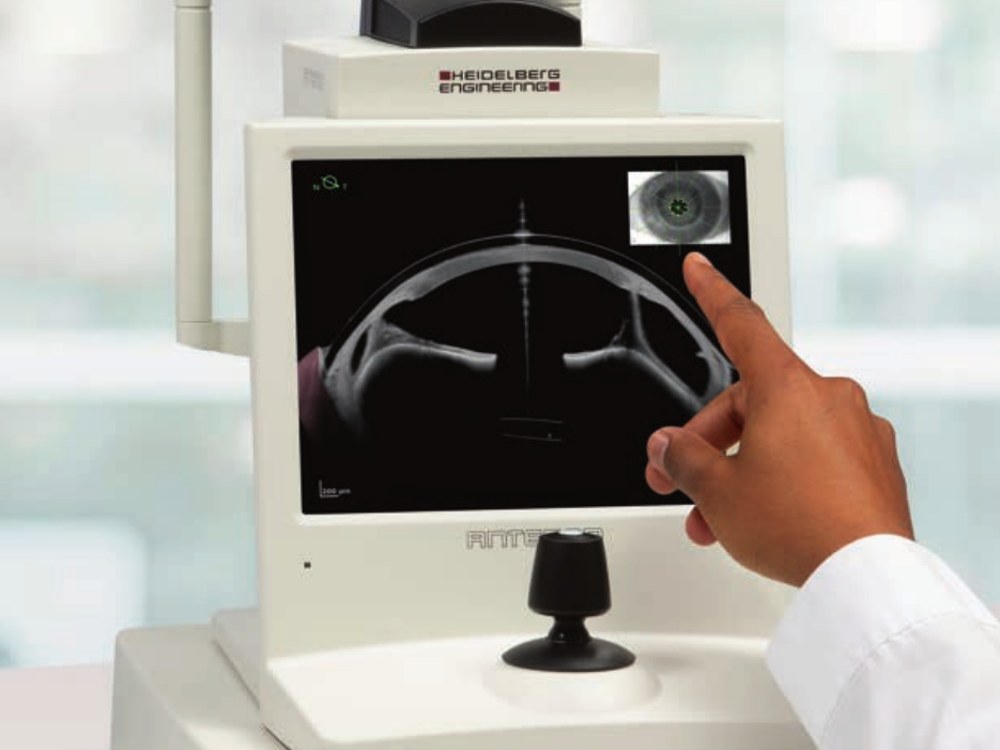
Diagnosis is based on detailed mapping of the cornea rather than a routine eye test alone. At Balaji Horizon Eye Hospital we use advanced corneal imaging, including Heidelberg ANTERION anterior-segment tomography, to measure corneal shape, thickness and curvature precisely. This allows us to detect keratoconus early, grade its severity and — importantly — track whether it is progressing over time.
Treatment is individualised and depends on the stage of disease, whether it is progressing, and how much your vision is affected. The aim is twofold: stop progression and restore clear vision.
In early disease, glasses or soft contact lenses may be enough. As astigmatism becomes irregular, specially fitted rigid gas-permeable or scleral contact lenses can give much sharper vision than glasses.
Cross-linking is the established treatment to halt progression. Using riboflavin (vitamin B2) drops and controlled ultraviolet light, it strengthens the bonds within the cornea. It does not usually reverse changes already present, but it can stabilise the cornea and reduce the chance of needing a transplant later — which is why early, timely treatment matters.
In selected cases, tiny ring segments placed within the cornea can help flatten the cone and improve the fit of contact lenses or the quality of vision.
When keratoconus is advanced and vision can no longer be corrected, a partial-thickness corneal transplant (DALK) — which preserves the patient’s own inner corneal layers — or a full-thickness graft may be considered. Dr. Jayadatt Patel is a fellowship-trained cornea and refractive surgeon with specific expertise in corneal transplantation.
Keratoconus is, above all, a condition where early diagnosis and timely cross-linking change the long-term outcome. Catching it before significant progression often means good vision can be maintained with lenses alone, and major surgery avoided.
It cannot be “cured”, but in most people it can be controlled. Cross-linking can halt progression, and lenses or surgery can restore useful vision. The earlier it is treated, the better the long-term outlook.
Complete blindness is very rare. Most people retain good functional vision with appropriate treatment; advanced cases that lose clarity can usually be helped with a corneal transplant.
Standard LASIK is not advised in keratoconus, as it can weaken the cornea further. This is exactly why careful corneal screening before any laser vision correction is so important.
It is done under anaesthetic drops. There is usually some discomfort and light sensitivity for a few days afterwards, which is managed with drops and follow-up.
This information is for general awareness and does not replace consultation with an eye specialist. Keratoconus management should always be individualised.
Concerned about keratoconus or a changing prescription? Book a corneal assessment with Dr. Jayadatt Patel. Related: Cornea & Corneal Transplant, Specialist Contact Lenses, Our Technology.
The cost of Keratoconus Treatment depends on your eyes, the technology and any lens or implant chosen, and your individual clinical needs. We give you a clear, written estimate after your examination — with no obligation — and explain exactly what is included.
Request a cost estimate on WhatsApp Call +91 92748 67875
We don't list fixed prices because the right treatment — and therefore the cost — varies from patient to patient.
Fellowship-trained cornea, refractive & cataract surgeon.
First in Gujarat with ANTERION & SPECTRALIS (GMPE).
Evidence-based, individualised advice — no overtreatment.
Convenient care at Science City & Naranpura, Ahmedabad.

MBBS, MS (Ophthalmology), FCRS — Cornea, Refractive & Ocular Surface Surgeon
Founder & Director of Balaji Horizon Eye Hospital and Consultant Cornea & Refractive Surgeon at C.H. Nagri Eye Hospital, Ahmedabad. Dr. Patel focuses on accurate diagnosis, vision preservation and individualised, ethical care.
View full profile →Same specialist care at both our Ahmedabad branches.